TOP500 June 2026: China Returns, Europe Expands, Exascale Competition Intensifies
China has returned to the forefront of supercomputing. For the first time since 2017, a Chinese system has topped the latest TOP500 list. The new number one, LineShine, is located at the National Supercomputing Center in Shenzhen and was developed by the Shenzhen Cloud Computing Center. It scored 2.198 exaflops on the High Performance LINPACK benchmark, utilizing nearly 14 million cores - over 20% faster than the second-place system.
Based on the custom LingKun platform, it features LX2 304-core 1.55 GHz processors with ARMv9 architecture, connected via the proprietary LingQi interconnect, and runs the Kylin operating system. In addition to leading the TOP500, LineShine also ranks among the most energy-efficient systems on the Green500, achieving around 52.0 gigaflops per watt.
Before officially topping the latest TOP500 list, China's LineShine supercomputer gained attention in April when it was revealed at a conference at the National Supercomputing Center in Shenzhen. Early reports labeled it China's fastest domestically created supercomputer and a fully indigenous project, built without foreign processors or accelerators.
These reports indicate that the development of LineShine is in two phases. The second phase, from April to mid-June, expands to 92 compute cabinets with around 47,000 CPUs, linked via 36 networking cabinets and a one-million-port interconnect fabric. Storage-wise, the system is equally impressive, featuring 67 liquid-cooled storage cabinets, 428 storage nodes, and a total bandwidth of 10 TB/s, making it one of China's largest storage systems ever deployed in an HPC system.
Behind China's new leader, the rest of the TOP500 top ten remains dominated by US and European systems. Lawrence Livermore National Laboratory's El Capitan takes second place with 1.8 exaflops, followed by Frontier in third and Aurora in fourth. Europe's strongest entry, JUPITER Booster at the Jülich Supercomputing Centre, ranks fifth. The list also includes new entrant HPC7 at Eni in sixth place, cloud-based Eagle by Microsoft Azure in seventh, HPC6 in eighth, Japan's former leader Fugaku in ninth, and Switzerland's Alps rounding out the top ten. Notably, HPE Cray systems continue to dominate the upper ranks, powering six of the ten fastest supercomputers in the world.
On the country-by-country list, the US continues to lead significantly with 162 systems on the TOP500 list. Japan is next with 44, followed by Germany with 41, and China with 30. When European countries are combined, including the UK, Europe totals approximately 154 systems, nearing the US.
Europe has reinforced its position as a global supercomputing leader in the latest TOP500 rankings, with the EuroHPC Joint Undertaking now represented on the list by all of its operational supercomputers. This marks another important milestone for Europe's strategy to build technological sovereignty in high-performance computing and artificial intelligence.
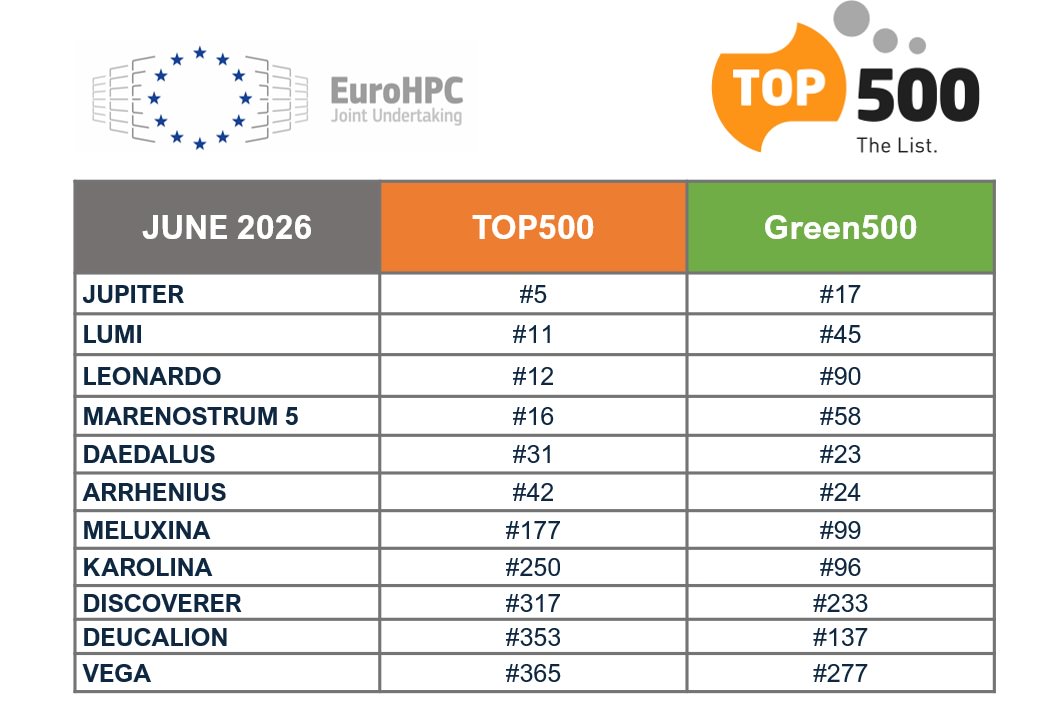
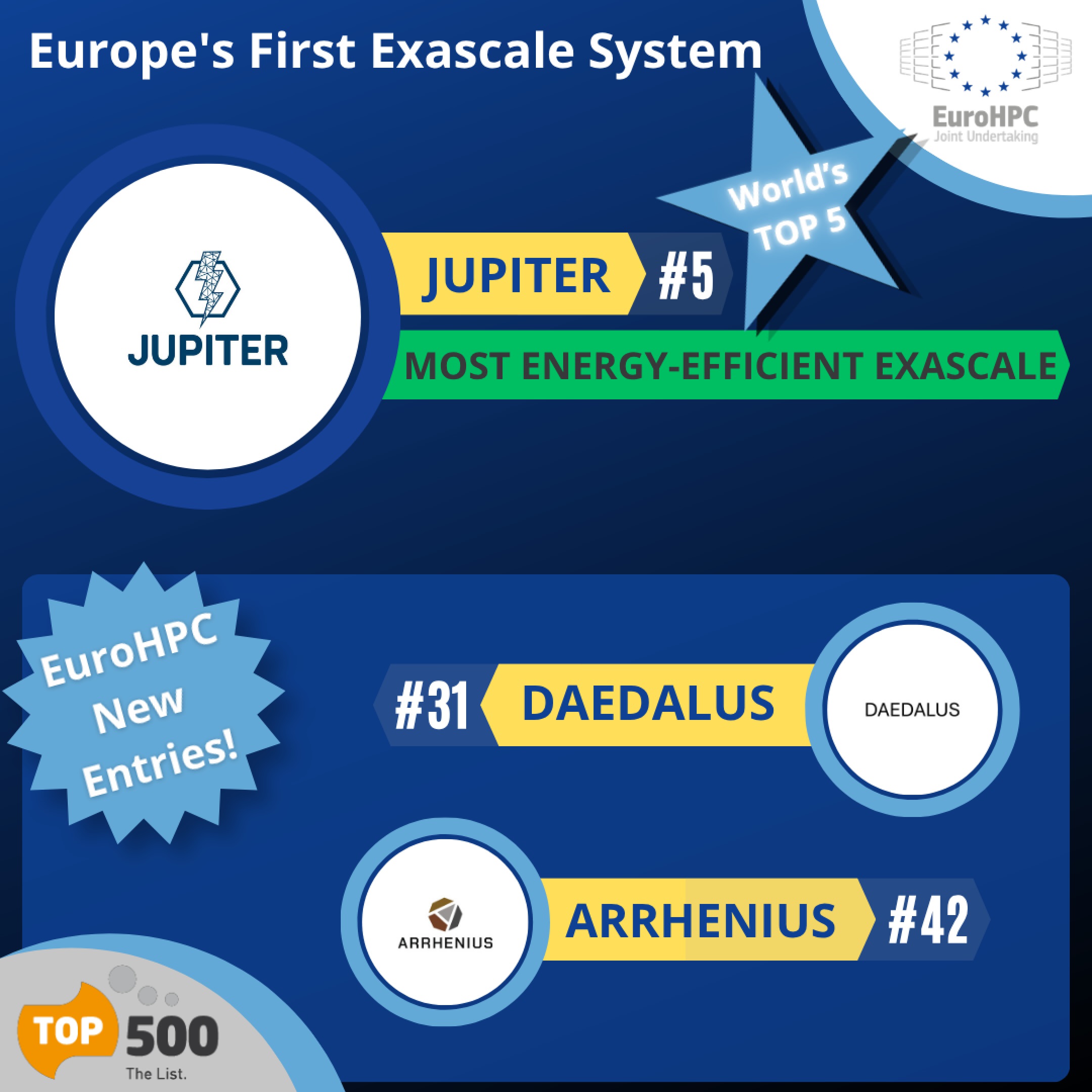
At the forefront is JUPITER, hosted by Forschungszentrum Jülich in Germany, which remains among the five most powerful supercomputers in the world. As Europe's first exascale-class system, JUPITER continues to demonstrate not only raw computational power but also exceptional energy efficiency, maintaining its status as one of the most efficient exascale systems globally. Its performance is expected to play a key role in advancing European research in climate modeling, health, engineering, and AI.
This year's TOP500 also welcomed two new EuroHPC systems into the global Top 50: DAEDALUS, hosted in Greece, and Arrhenius, located in Sweden. Their addition further expands Europe's distributed supercomputing infrastructure and strengthens access to advanced HPC resources across the continent. Together with established systems such as LUMI in Finland, Leonardo in Italy, and MareNostrum 5 in Spain, Europe now operates one of the most comprehensive and diverse HPC ecosystems in the world.
Beyond rankings, these achievements reflect Europe's long-term investment in digital sovereignty, scientific excellence, and industrial competitiveness. Through EuroHPC, the European Union continues to build a federated HPC infrastructure that supports cutting-edge research, accelerates innovation for businesses and startups, and provides the computational backbone for Europe's AI ambitions.